Metacognitive Monitoring and Control
The previous cognitive architecture explained the structure of cognition — how the Autonomous, Algorithmic, and Reflective minds interact across the Object Level and Meta Level.
The model presented here (Ackerman & Thompson, 2017) focuses on something slightly different: the temporal process of reasoning. Instead of showing where cognition occurs, it explains how reasoning unfolds over time during a task.
In other words:
- The architecture model describes the components of the mind.
- This chronological blueprint describes the workflow of reasoning and metacognitive regulation.
The diagram organizes cognition into three interacting streams:
- Reasoning (Object Level execution)
- Metacognitive Monitoring (evaluation of reasoning)
- Metacognitive Control (strategic regulation)
Together, these processes form a continuous loop in which the mind solves problems while simultaneously evaluating and regulating its own reasoning.
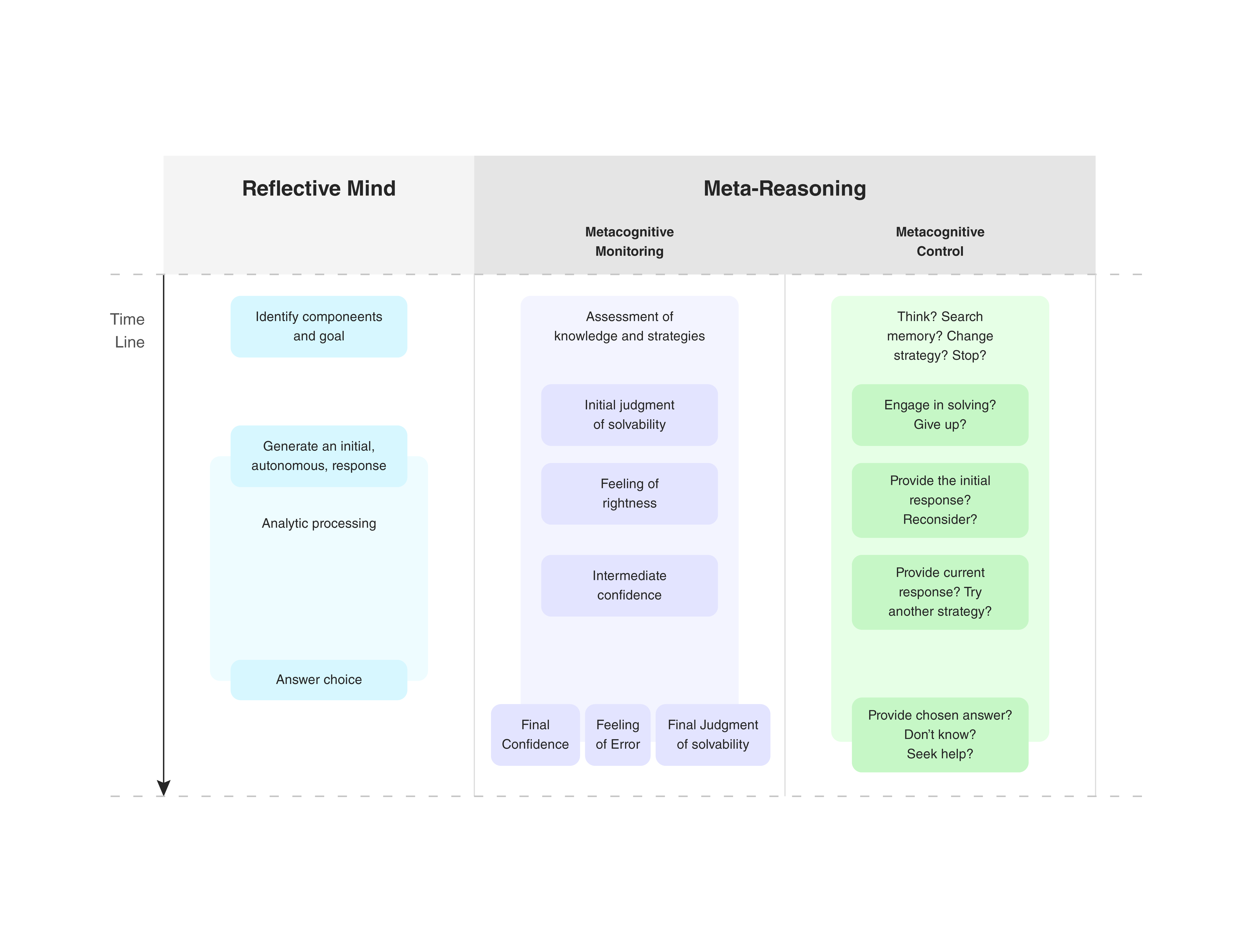
The Chronological Blueprint of Metacognitive Reasoning
During a reasoning task, cognition progresses through several stages.
The timeline begins with problem identification, proceeds through initial intuition and analytical processing, and ends with a final answer and confidence judgment.
Throughout this process, metacognition performs two core functions:
- Monitoring — sensing the state of reasoning
- Control — deciding what actions to take
These two functions allow the cognitive system to dynamically adjust how much effort should be invested in solving a problem.
1. The Reasoning Column — Object Level Cognition
The Reasoning column represents the Object Level, where the task itself is executed.
This column primarily involves:
- the Autonomous Mind (Type 1 processing)
- the Algorithmic Mind (Type 2 execution)
The reasoning process typically unfolds in several stages.
Identifying the Components and Goal
The reasoning process begins by understanding the problem.
The cognitive system identifies:
- the goal of the task
- relevant components of the problem
- constraints or rules that apply
This stage prepares the system for subsequent reasoning steps.
Generating an Initial Autonomous Response
Once the problem is recognized, the Autonomous Mind produces a rapid intuitive response.
This response is generated through:
- pattern recognition
- learned heuristics
- prior experience
Because it is fast and automatic, this response may be useful but potentially biased.
This stage corresponds to Type 1 processing.
Analytic Processing
If the problem requires deeper reasoning, the Algorithmic Mind engages in analytic processing.
This stage involves:
- working memory usage
- logical reasoning
- step-by-step analysis
- evaluation of multiple variables
Here the system performs the computational work of reasoning.
This corresponds to Type 2 execution.
Selecting an Answer
Eventually, the reasoning process produces an answer choice.
However, reasoning does not stop here.
Before committing to the answer, the system evaluates how confident it is in the solution.
This is where metacognition becomes critical.
2. Metacognitive Monitoring — Evaluating the Reasoning Process
The Monitoring column acts as the bridge between reasoning and regulation.
Its role is to continuously evaluate the state of cognition.
Monitoring relies on metacognitive cues, which are signals that indicate how well reasoning is progressing.
These cues can originate from both automatic intuition and deliberate evaluation.
Initial Judgment of Solvability
Very early in the reasoning process, individuals often form a quick judgment about whether a problem appears solvable.
This initial judgment of solvability is typically generated automatically.
It answers questions such as:
- “Does this problem look familiar?”
- “Do I know how to approach it?”
This judgment helps determine whether the system should invest effort in solving the problem.
Feeling of Rightness
After producing an initial answer, the system often experiences a feeling of rightness.
This is an intuitive sense that the answer “feels correct”.
The feeling of rightness acts as a fast heuristic signal indicating whether further analysis is necessary.
If the answer feels highly convincing, the system may stop searching for alternatives.
If the feeling is weak, deeper reasoning may be triggered.
Intermediate Confidence
As reasoning continues, monitoring produces intermediate confidence judgments.
At this stage the individual evaluates:
- how well the reasoning process is progressing
- whether the strategy being used is effective
- whether the current answer seems reliable
These intermediate evaluations influence whether the reasoning process continues or changes direction.
Final Confidence
After an answer is generated, the system produces a final confidence judgment.
This is a deliberate assessment of how trustworthy the answer is.
High confidence leads to committing to the answer.
Low confidence may lead to reconsidering the reasoning process.
Feeling of Error
Sometimes individuals experience a feeling of error.
This is a metacognitive signal indicating that something in the reasoning process seems incorrect or inconsistent.
Even if the correct answer cannot be immediately identified, this signal can trigger further evaluation or strategy revision.
Final Judgment of Solvability
At the end of the reasoning process, individuals often make a final judgment of solvability.
This judgment answers questions such as:
- “Was this problem actually solvable?”
- “Did I reach the correct solution?”
- “Should I revisit the problem later?”
These judgments influence future learning and problem-solving strategies.
3. Metacognitive Control — Strategic Regulation of Reasoning
The Control column represents the Reflective Mind operating at the Meta Level.
While monitoring detects signals about reasoning quality, control uses those signals to guide decisions.
This is where deliberate metacognition performs cognitive management.
Deciding Whether to Engage in Problem Solving
The first control decision is whether to engage in solving the problem at all.
Based on monitoring signals, the system may decide to:
- invest effort in solving the task
- postpone the task
- abandon it entirely
Evaluating the Initial Response
Once an intuitive response has been generated, the reflective system decides whether to accept or reconsider it.
Questions considered at this stage include:
- Should the initial response be trusted?
- Should deeper reasoning be applied?
- Should additional evidence be considered?
This stage determines whether Type 2 reasoning should override intuition.
Adjusting Strategy
During analytic reasoning, monitoring signals may indicate that the current strategy is not working.
The reflective system may then decide to:
- modify the strategy
- search memory for different mindware
- try an alternative approach
This dynamic adjustment prevents the system from persisting with ineffective strategies.
Deciding When to Stop
The reflective system must also decide when reasoning should stop.
Possible decisions include:
- providing the final answer
- admitting uncertainty (“I don’t know”)
- seeking external help
- allocating more time to the task
This regulation allows the mind to manage limited cognitive resources effectively.
Metacognitive Cues and Resource Allocation
An important insight from this model is that metacognitive cues guide the allocation of cognitive resources.
Signals such as:
- feeling of rightness
- confidence judgments
- perceived solvability
help determine:
- how much effort to invest
- how long to continue reasoning
- whether additional strategies should be explored
In this way, metacognition functions as a resource management system for cognition.
Integration with the Cognitive Architecture
This chronological model aligns closely with the earlier Autonomous–Algorithmic–Reflective framework.
| Component | Role in the Process |
|---|---|
| Autonomous Mind | Generates initial intuitive responses |
| Algorithmic Mind | Performs analytic reasoning |
| Reflective Mind | Monitors reasoning and regulates strategy |
Thus:
- Reasoning column → Object Level cognition
- Monitoring column → Metacognitive signals bridging levels
- Control column → Reflective Mind regulating cognition
Summary
The Metacognitive Monitoring and Control model describes how reasoning unfolds over time while being continuously evaluated and regulated.
The process consists of three interacting streams:
- Reasoning — performing the cognitive task
- Monitoring — evaluating the state of reasoning
- Control — regulating strategies and decisions
Metacognitive cues generated during reasoning allow the reflective system to decide:
- whether to continue reasoning
- whether to change strategies
- when to stop or seek help
Through this dynamic loop, the mind is able to adaptively manage cognitive effort and improve the quality of decision-making.