Cognition: A dual process
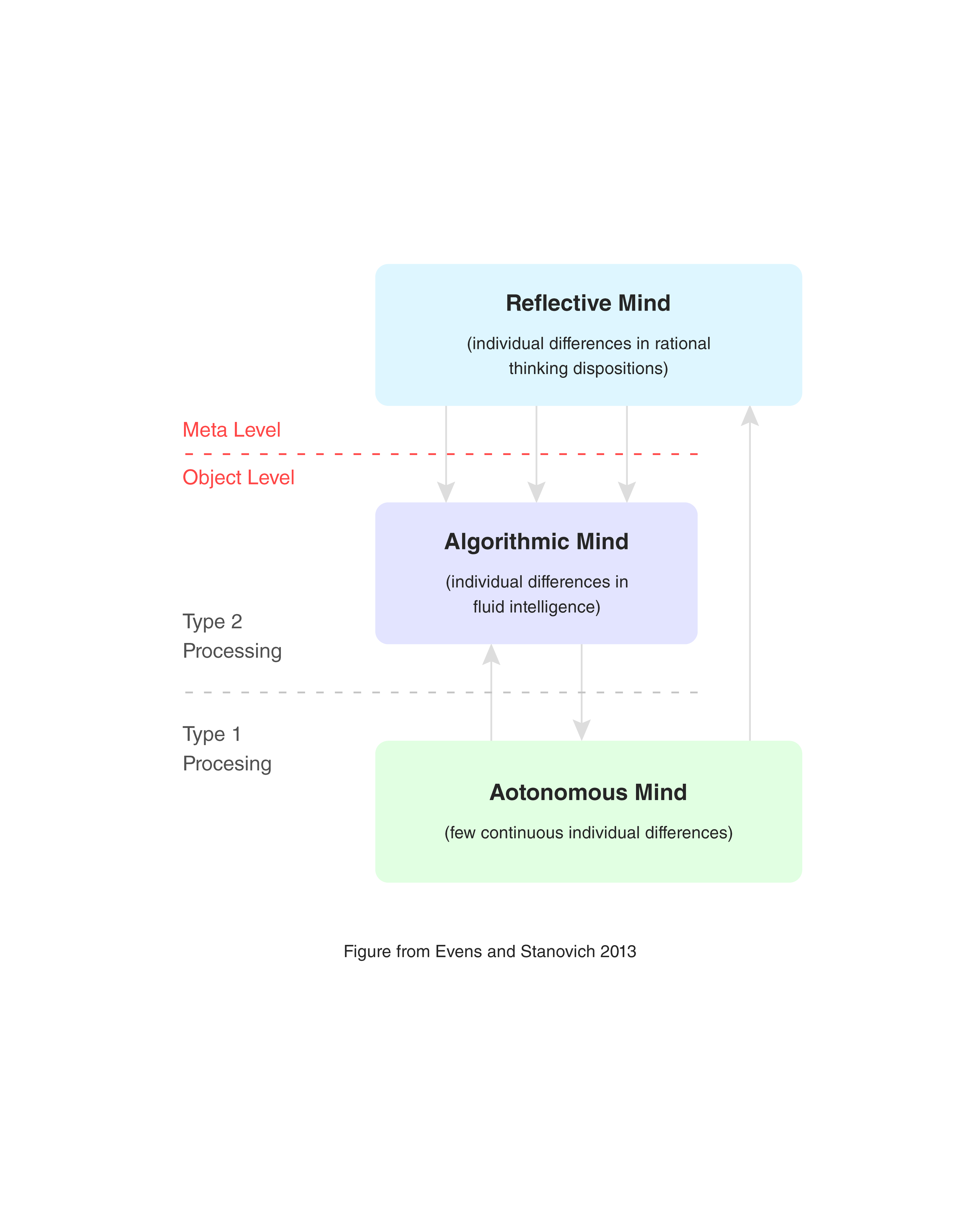
Meta-Cognition and Dual Process Architecture
The diagram (adapted from Evans & Stanovich, 2013) expands traditional Dual Process Theory by distinguishing three interacting cognitive layers:
- Autonomous Mind
- Algorithmic Mind
- Reflective Mind
These layers explain how Type 1 (fast) and Type 2 (slow) cognition operate and how metacognition regulates the overall reasoning process.
The architecture can also be interpreted using the Object Level / Meta Level model of cognition:
- Object Level: Performs cognitive tasks.
- Meta Level: Monitors and regulates those tasks.
Structure of the Model
The model is organized into two major processing categories:
Type 1 Processing — Fast Thinking
Type 1 cognition consists of:
- automatic
- fast
- low-effort
- heuristic-based reasoning
It produces immediate intuitive responses.
These processes are largely generated by the Autonomous Mind.
Examples include:
- pattern recognition
- immediate judgments
- emotional reactions
- habitual responses
Humans therefore perform fast thinking from a collection of autonomous processes.
However, these processes may produce biased or incorrect answers, which is when slower reasoning systems intervene.
Type 2 Processing — Slow Thinking
Type 2 cognition involves:
- deliberate reasoning
- rule-based thinking
- multi-step problem solving
- working memory usage
However, Type 2 itself contains two distinct components:
- Algorithmic Type 2 — executing reasoning
- Metacognitive Type 2 — controlling reasoning
Within these processing types, three cognitive components interact:
1. Autonomous Mind
2. Algorithmic Mind
3. Reflective Mind
Three-Layer Cognitive Architecture
1. Autonomous Mind (Type 1 Processing)
The Autonomous Mind corresponds to the object-level fast cognition responsible for automatic mental operations.
Characteristics:
- Rapid, automatic responses
- Minimal cognitive effort
- Based on learned patterns, heuristics, and associations
- Often unconscious
Functions include:
- heuristic reasoning
- emotional judgments
- quick pattern recognition
- intuitive decisions
In AI analogy, this resembles fast inference mechanisms where pre-learned models quickly generate outputs without extensive deliberation.
These responses often generate the first answer to a problem. However, they can also introduce biases and cognitive errors.
Because of this, the system occasionally activates slow thinking when the autonomous answer appears unreliable.
An occasional slow thinking process is triggered when the system detects that the autonomous processes may be incorrect.
2. Algorithmic Mind (Execution Layer of Type 2 Processing)
The Algorithmic Mind represents the computational capacity of the brain, including:
- Working memory
- Cognitive processing speed
- Logical reasoning ability
- Fluid intelligence
This layer performs structured reasoning but does not decide when or why to use it.
Instead, it executes the strategies provided by the reflective system.
Examples of algorithmic tasks include:
- solving mathematical equations
- evaluating logical conditions
- comparing multiple variables
- step-by-step reasoning
In AI analogy:
- the Reflective Mind acts like the planner
- the Algorithmic Mind acts like the CPU executing instructions
Within the Object Level, the algorithmic system:
- The Algorithmic Mind largely operates at the object level
- performs Type 1 inferences generated by the Autonomous Mind
- It executes Type 2 reasoning strategies that may be triggered or guided by the meta level.
Thus:
The object level is responsible for Type 1 fast inferences and the execution of Type 2 reasoning, but the strategies guiding these processes may originate at the meta level.
3. Reflective Mind (Meta-Level Cognition)
The Reflective Mind represents the metacognitive control system.
This layer evaluates, monitors, and regulates thinking processes occurring at lower levels. Hence Its role is cognitive management.
Key functions include:
- Monitoring cognitive performance
- evaluating correctness of reasoning
- Deciding when fast intuition should be overridden
- Selecting reasoning strategies
- Allocating mental resources
- Evaluating whether a solution is satisfactory
- regulating problem-solving processes
This is why the reflective mind is considered a metacognitive process.
It determines:
- whether more analytical reasoning is required
- which reasoning strategy should be used and when
- how much working memory should be allocated
- whether the initial intuitive answer should be questioned
For example:
- noticing a logical inconsistency
- deciding to double-check a calculation
- reconsidering a previously accepted assumption
In essence, it answers questions such as:
- How should I solve this problem?
- Is my reasoning reliable?
- Should I reconsider my approach?
Therefore, the reflective mind determines when computationally intensive Type 2 reasoning should be triggered.
Relationship with Object Level and Meta Level
This architecture maps well to the Object Level / Meta Level model of cognition.
Object Level
The object level includes:
- Autonomous processes (fast intuitive thinking)
- Algorithmic processes (execution of analytical reasoning)
It is responsible for performing cognitive tasks, including:
- perception
- learning
- reasoning
- problem solving
In terms of processing types:
Object level handles:
- Type 1 fast cognition
- execution of Type 2 reasoning
But it does not decide strategy.
Meta Level
The meta level corresponds to the Reflective Mind.
It performs metacognitive regulation, including:
- monitoring object-level cognition
- evaluating correctness of responses
- selecting problem-solving strategies
- deciding when to switch from fast to slow thinking
This level becomes active particularly when:
- intuitive responses appear unreliable
- problems are complex
- conflicting information arises
- strategic planning is required
Thus:
An occasional “slow thinking” process is activated when the reflective system detects that autonomous processes may be incorrect.
Metacognition as Type 2 Control
It is important to distinguish two forms of Type 2 processing:
1. Algorithmic Type 2 (Execution)
This involves performing analytical reasoning.
Examples:
- solving equations
- logical deduction
- structured calculations
This is computational and executed primarily by the algorithmic mind.
2. Metacognitive Type 2 (Control)
This involves thinking about how thinking should occur.
It includes:
- choosing strategies
- evaluating reasoning
- exploring alternative approaches
- allocating cognitive effort
This is handled by the reflective mind.
In simple terms:
Algorithmic Type 2 asks:
What is the solution?
Reflective Type 2 asks:
How should I approach this problem?
The Process
Choosing the Strategy
The Reflective Mind evaluates the nature of the problem and selects the appropriate Mindware — the rules, strategies, and procedures required for solving the problem.
Mindware represents the toolbox of reasoning methods stored in memory.
Examples include:
- logical rules
- statistical reasoning
- planning strategies
- decision frameworks
Example:
If you are playing chess, the reflective mind might decide:
“My king is exposed, therefore I should switch to a defensive strategy.”
This illustrates that the reflective system determines how a problem should be approached.
The Decision to Override Intuition
One of the most important roles of the Reflective Mind is detecting when fast intuition may be wrong.
If the Autonomous Mind generates a biased response, the reflective system may:
- pause the intuitive response
- activate deeper reasoning
- trigger the Algorithmic Mind
This is the moment when Type 2 reasoning begins.
Thus the reflective system acts as an auditor of intuition.
Executing the Strategy
Once a strategy has been selected, the Algorithmic Mind becomes the workhorse of reasoning.
Its responsibilities include:
- maintaining working memory
- tracking multiple variables
- executing multi-step logic
- performing computations
It is essentially the CPU running the software chosen by the Reflective Mind.
Example:
If the reflective system chooses a statistical reasoning strategy, the algorithmic system performs:
- calculations
- comparisons
- logical evaluations
Continuous Re-Evaluation
Metacognition also performs continuous monitoring during reasoning.
As the Algorithmic Mind processes information, the Reflective Mind observes the process and asks:
- Is this strategy still working?
- Am I making progress toward the goal?
- Should I reconsider my approach?
Example:
If someone spends 10 minutes solving a math problem with no progress, the reflective system may decide to:
- stop the current reasoning path
- select a different strategy
- re-frame the problem
This monitoring ability is crucial for adaptive reasoning.
If the reflective system is weak or ineffective, individuals may persist with failing strategies indefinitely, even if they possess strong computational abilities.
Exploring Possibilities
Exploration of alternatives involves a loop between the Reflective and Algorithmic systems.
Step 1 — Reflective Mind initiates simulation
The reflective system proposes a hypothetical scenario.
Example:
“What would happen if we moved the office to London?”
Step 2 — Algorithmic Mind performs cognitive decoupling
The algorithmic system creates a mental simulation by temporarily separating from reality.
It evaluates:
- costs
- logistics
- travel time
- resource requirements
This process is known as cognitive decoupling.
Step 3 — Reflective Mind evaluates simulation results
The reflective system then examines the results of the simulation and decides:
- whether the scenario is viable
- which strategy should be used next
- whether additional simulations are required
This interaction forms a reasoning loop between reflection and computation.
Mindware — The Missing Link
Mindware refers to the collection of rules, strategies, knowledge structures, procedures, and reasoning tools that a thinker can apply to solve problems and make decisions. The concept was introduced prominently by cognitive scientist Keith Stanovich to explain why intelligence alone does not guarantee rational thinking.
Mindware acts as the software of cognition. Just as a computer requires both hardware and software to perform meaningful tasks, human reasoning requires both computational capacity (Algorithmic Mind) and appropriate reasoning tools (Mindware).
Without proper mindware, even a highly intelligent individual may fail to reason effectively.
Mindware in the Cognitive Architecture
Within the Autonomous–Algorithmic–Reflective framework, mindware connects the layers of cognition.
| Component | Role with Mindware |
|---|---|
| Reflective Mind | Selects which mindware should be used |
| Algorithmic Mind | Executes the rules and procedures |
| Autonomous Mind | May contain automatized mindware (habits or learned heuristics) |
Thus:
- Reflective Mind → chooses the strategy
- Algorithmic Mind → applies the strategy
- Autonomous Mind → may apply previously internalized mindware automatically
Some examples of Mindware
Mindware can take many forms depending on the domain of reasoning.
Logical Mindware
These include formal reasoning structures used to evaluate arguments.
Examples:
- deductive logic
- syllogistic reasoning
- conditional reasoning rules
- propositional logic
Logical mindware helps individuals evaluate whether conclusions follow logically from premises.
Example:
If someone understands logical implication, they can correctly reason about statements such as:
If A implies B, and A is true, then B must be true.
Statistical and Probabilistic Mindware
Many real-world decisions require reasoning under uncertainty.
Examples include:
- probability theory
- Bayesian reasoning
- statistical inference
- base rate reasoning
- risk evaluation
Without probabilistic mindware, people frequently commit biases such as:
- base rate neglect
- gambler’s fallacy
- misunderstanding randomness
Decision-Making Mindware
These strategies guide rational decision processes.
Examples include:
- cost–benefit analysis
- expected value calculations
- optimization strategies
- trade-off evaluation
These forms of mindware are critical for economic, policy, and strategic decisions.
Planning and Strategic Mindware
Complex tasks often require structured planning.
Examples include:
- goal decomposition
- constraint evaluation
- multi-step planning strategies
- search strategies (such as minimax in chess)
Strategic mindware allows individuals to organize reasoning across time and multiple steps.
Mindware Acquisition
Mindware is not innate; it must be exposed, learned and internalized through:
- exposure
- training
- experience
- exposure to reasoning frameworks
Over time, frequently used mindware may become automatized, transitioning from slow Type 2 reasoning into faster Type 1 processes.
Mindware Gaps
A mindware gap occurs when a person lacks the necessary cognitive tools for solving a problem.
For example:
A person might be highly intelligent but fail to solve a probability puzzle because they never learned probabilistic reasoning rules.
This explains why:
- high IQ actors can still make irrational decisions
- exposure and training on this aspect can dramatically improve reasoning quality
- expertise often depends on domain-specific reasoning tools
Mindware and Rational Thinking
Keith Stanovich distinguishes between intelligence and rationality.
- Algorithmic Mind → determines computational power (IQ-like abilities)
- Reflective Mind → determines willingness to think critically
- Mindware → determines whether correct reasoning tools are available
Rational thinking therefore depends on the interaction of all three.
Even with strong computational ability, reasoning will fail if:
- the reflective system fails to select the right strategy, or
- the thinker lacks the appropriate mindware.
Example: Mindware in Action
Consider a medical diagnosis problem.
-
Autonomous Mind
Provides a quick intuitive guess about the disease. -
Reflective Mind
Recognizes that intuition may be unreliable and decides to use statistical reasoning. -
Mindware Selected
Bayesian reasoning rules are selected. -
Algorithmic Mind
Performs the probability calculations. -
Reflective Mind
Evaluates the result and decides whether further reasoning is needed.
In this process:
- Mindware provides the reasoning framework
- Algorithmic Mind performs the computations
- Reflective Mind manages the reasoning process
The Library for Mind
Mindware represents the library of reasoning tools available to a thinker.
It includes:
- logical rules
- probabilistic reasoning
- scientific reasoning methods
- decision frameworks
- strategic planning procedures
Within the cognitive architecture:
- Reflective Mind selects the appropriate mindware
- Algorithmic Mind executes it
- Autonomous Mind may apply well-learned mindware automatically
Thus, rational thinking requires not only computational intelligence, but also the correct cognitive tools to guide reasoning.
Mindware therefore forms the critical bridge between intelligence and rational decision-making.
Failure Modes in the System
Two major failure modes can occur in this architecture.
Reflective Mind Failure — Dysrationalia
Dysrationalia refers to poor rational thinking despite high intelligence.
This occurs when the reflective system:
- fails to detect biases
- fails to select appropriate strategies
- fails to regulate reasoning processes
Algorithmic Mind Failure — Resource Limitation
The algorithmic system may fail due to limited cognitive resources such as:
- insufficient working memory
- low processing capacity
- difficulty handling complex computations
In this case the individual knows the correct strategy but cannot execute it effectively.
Comprehensive Comparison
| Feature | Reflective Mind (The Architect) | Algorithmic Mind (The Builder) |
|---|---|---|
| Strategy Selection | Primary. Chooses which reasoning tool to use. | None. Executes the chosen strategy. |
| Monitoring | Primary. Evaluates progress and logic. Asks "Are we being logical?" or "Is this working?" | None. Executes instructions until told to stop. |
| Possibility Exploration | Sets the parameters. , Defines what scenarios should be simulated. | Runs simulations and calculations. |
| Effort Regulation | Decides how much cognitive effort to allocate. | Consumes working memory and processing resources. |
| Failure Mode | Dysrationalia (poor rational strategy selection). | Resource limitations (insufficient compute). |
The Complete Reasoning Loop
When humans encounter a complex problem, cognition follows a structured loop:
- Autonomous processes generate fast intuitive responses (Type 1).
- Reflective Mind audits that response and asks:
“Is there a better way to solve this?” - When a problem requires deeper reasoning, the reflective mind evaluates whether further analysis is necessary.
- If required, it activates algorithmic reasoning processes.
- The reflective system searches memory for Mindware.
- The Reflective Mind selects a reasoning strategy.
- The strategy is passed to the Algorithmic Mind.
- The Algorithmic Mind executes the reasoning steps.
- The Reflective Mind monitors the output and decides whether to:
- continue
- adjust
- or pivot to another strategy.
Summary
The Evans and Stanovich cognitive architecture integrates dual-process theory with metacognitive control.
Three systems interact:
| Component | Role | Processing Type |
|---|---|---|
| Autonomous Mind | Fast intuitive responses | Type 1 |
| Algorithmic Mind | Executes analytical reasoning | Type 2 (execution) |
| Reflective Mind | Monitors and regulates cognition | Type 2 (metacognitive control) |
In simplified terms:
- Autonomous Mind → gives the first answer
- Reflective Mind → decides how to think
- Algorithmic Mind → performs the reasoning
Together these systems explain how humans transition between intuition, reasoning, and metacognitive control during complex problem solving.